Step 1 of 5 in the shadow AI governance guide. How to find unapproved AI tools, accounts, and agents before writing a single policy.
The short answer: Shadow AI discovery is the continuous process of finding every AI tool, account, and agent your people use, whether or not IT approved it. Capture AI activity at the browser and endpoint, record each tool in a catalog with an owner and an approval decision, and close the gaps where monitoring does not reach. Do this before you write policy, because you cannot govern what you cannot see.
Why discovery has to come before policy
A policy written before you know the footprint is wrong in both directions. It blocks the tools people need and misses the ones that matter. An approved list built from guesses is out of date the day you publish it.
Your existing tools were not built for this. Cloud access security broker (CASB) and secure web gateway tools were built for documents and email. They can show that someone visited a site. They typically do not show which desktop AI apps are running, whether a command-line interface (CLI) tool is sending code to a model, or whether a person or an agent was on the other end.
Shadow AI is any AI tool, account, or agent used without IT approval or oversight, and it is already in your finance, engineering, and operations teams. Discovery turns "we think we have a few" into a list with owners.
How to run shadow AI discovery in five steps
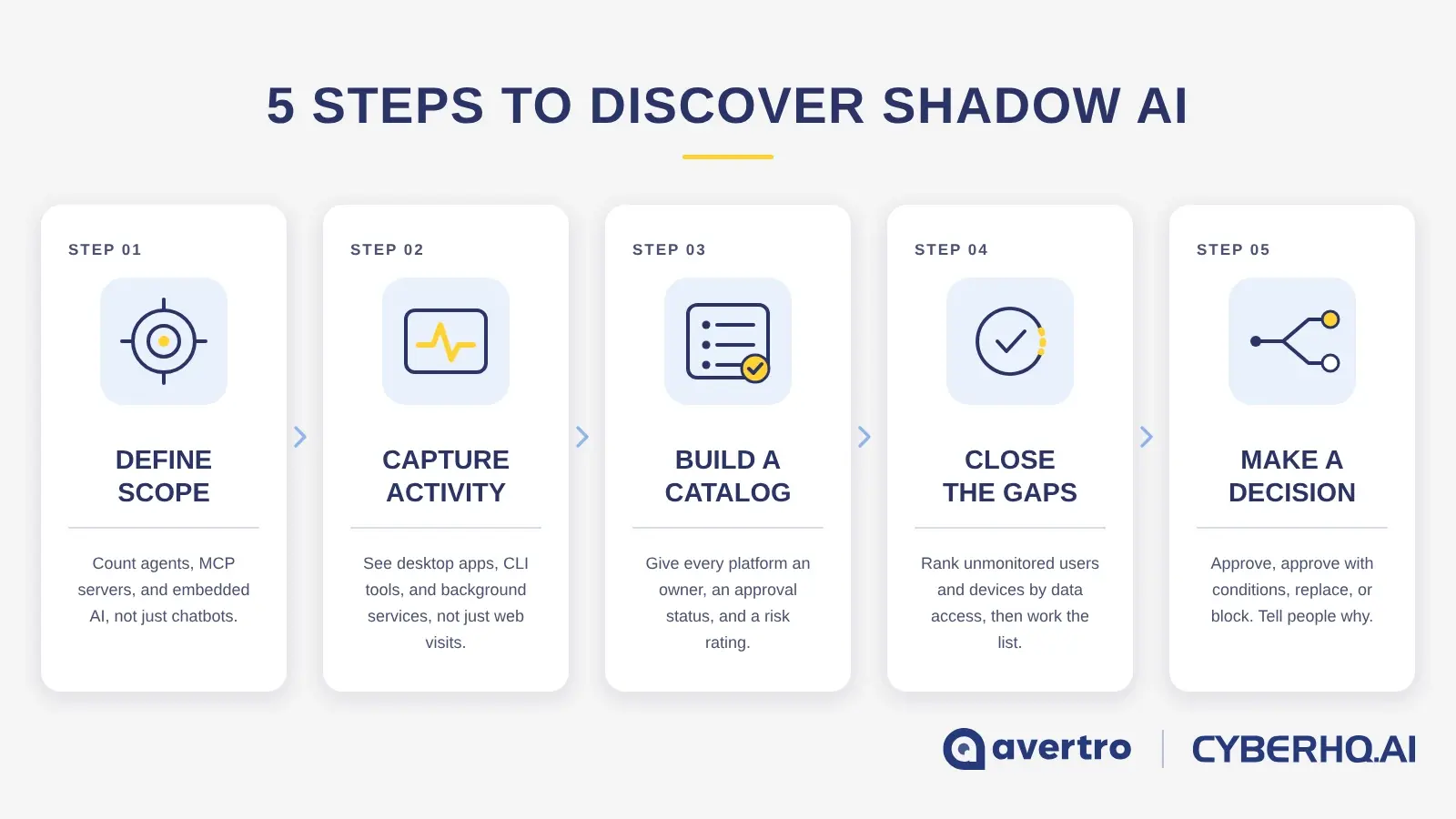
1. Define what counts as an AI tool
Scope decides what you find. Count more than chatbots:
-
Standalone AI platforms, such as chat assistants, coding assistants, and writing tools.
-
AI features embedded in tools you already license.
-
Personal accounts used for work on otherwise approved platforms.
-
Agents, scheduled automations, and Model Context Protocol (MCP) servers that act without a person in the session.
2. Capture AI activity where it happens
Browser and endpoint telemetry sees what network controls miss: desktop AI apps, CLI tools, and background services. Where your privacy posture allows, record which platform and which user, not the content of every page.
3. Build a platform catalog
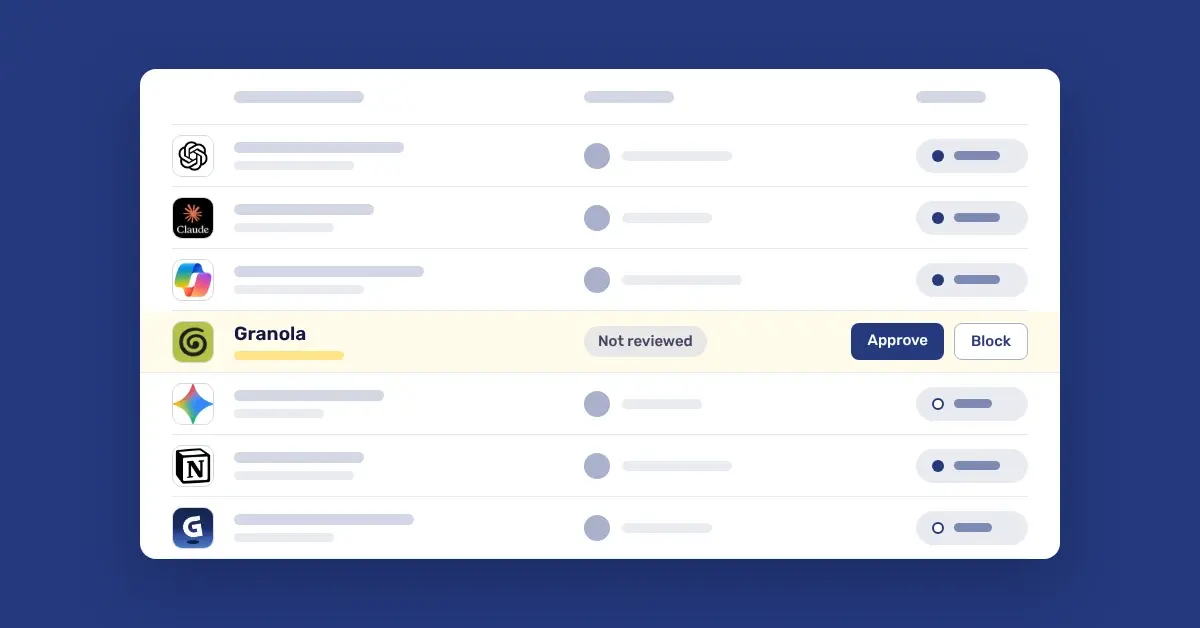
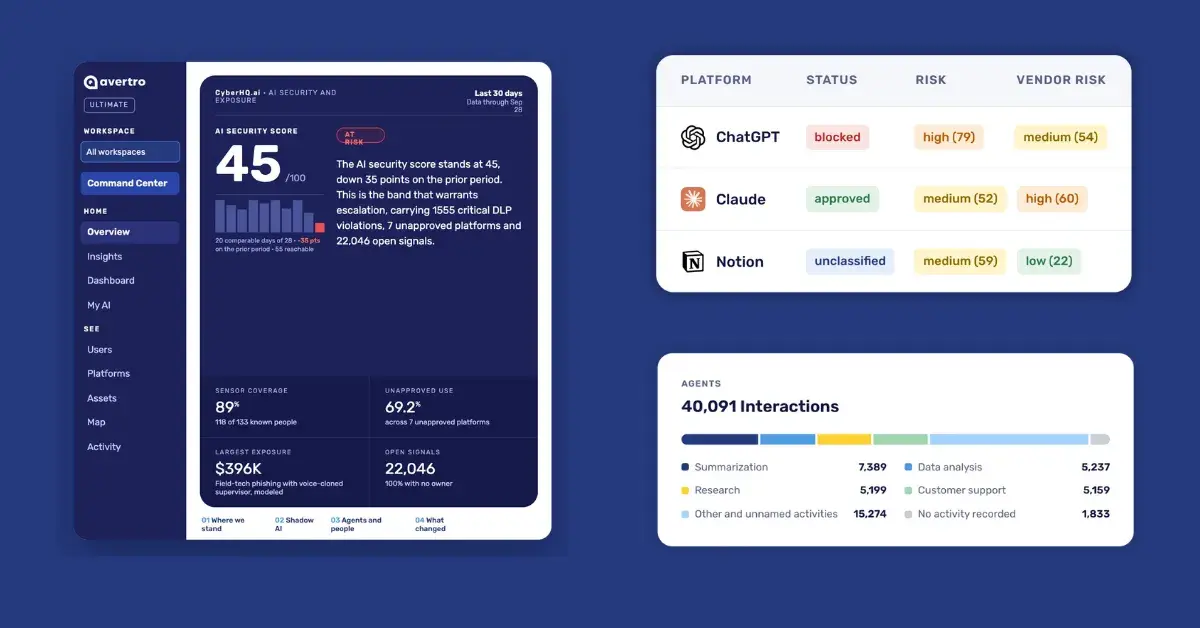
Give every AI platform you detect a record: vendor, owner, approval status, data handling terms, and a risk rating. Require an approve or block decision the first time a new platform appears, with a named person and a deadline. "Unknown" should be a state that expires.
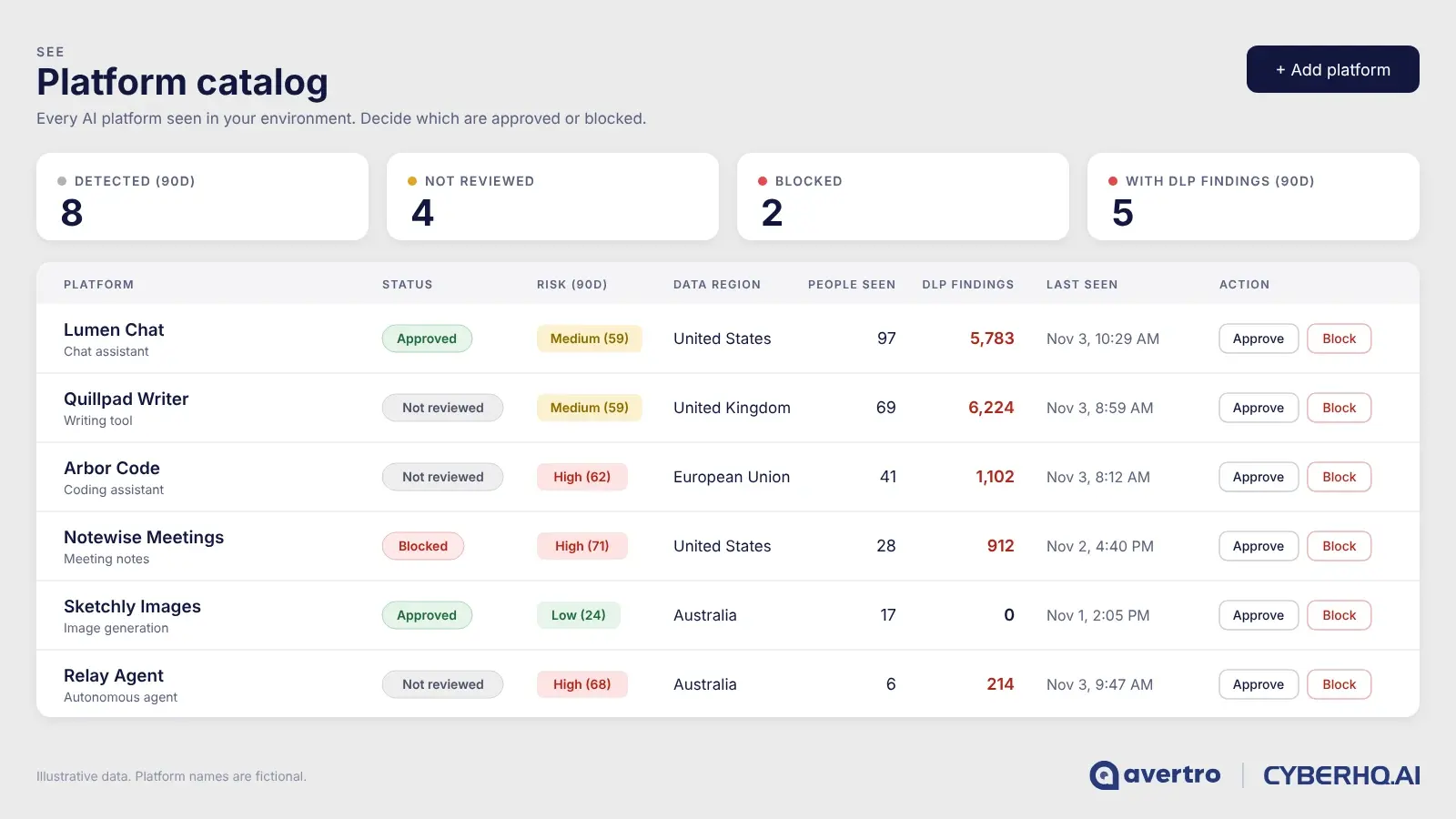
UI mock up of platform catalog in CyberHQ.ai
4. Close coverage gaps
Discovery only covers the people you can see. List every user and device without AI visibility, rank the gaps by access to sensitive data, and work the list on a schedule. Unmanaged devices and contractors are common gaps.
5. Turn findings into decisions
Every discovered tool ends in one of four outcomes: approve, approve with conditions, replace with a sanctioned alternative, or block. Tell people which, and why. Say what you monitor and why, and discovery reads as protection, not surveillance.
What good looks like: every AI tool in use has an owner, an approval status, and a decision date. "Unknown" is a state with a deadline attached.
How to measure shadow AI discovery
Report four numbers to your CISO and board:
-
Coverage: the share of users and devices with AI visibility.
-
Unapproved share: the proportion of AI activity on platforms with no approval decision.
-
Time to decision: how long a newly detected platform waits for an approve or block decision.
-
Unowned tools: AI platforms and agents with no named owner.
A falling unapproved share with stable coverage means the program is working. A falling unapproved share with falling coverage means you have lost visibility, not reduced risk.
How CyberHQ.ai fits
CyberHQ.ai gives business leaders the evidence to govern AI without blocking it: which tools people use, who or what is using them, and what data is moving. It is not a replacement for the existing security stack. It sits alongside CASB, data loss prevention (DLP), and security information and event management (SIEM) tools and provides the AI-specific context those tools were not built to deliver.
-
See: every AI tool in use, and whether each session is a person or an agent.
-
Act: sensitive data caught in prompts and pastes, with you choosing what and when to enforce.
-
Prove: an AI Security Score and framework evidence your board and auditors can test, including ISO/IEC 42001, NIST AI RMF, the EU AI Act, and MITRE ATLAS.
It deploys in under 30 minutes with no proxy or SSL inspection, and meaningful DLP findings typically appear within 24 to 48 hours. See plans and capabilities.
Trial CyberHQ.ai against your own AI footprint and see which AI tools your people are using, whether each session is a person or an agent, which licenses sit idle, and what sensitive data is moving. Start your free 30-day CyberHQ.ai trial, no credit card required.
Continue the guide
Shadow AI discovery is Step 1 of 5. Next: Step 2, use AI session monitoring to tell humans from autonomous agents. Or read the full guide, How to Govern Shadow AI Without Blocking Innovation.