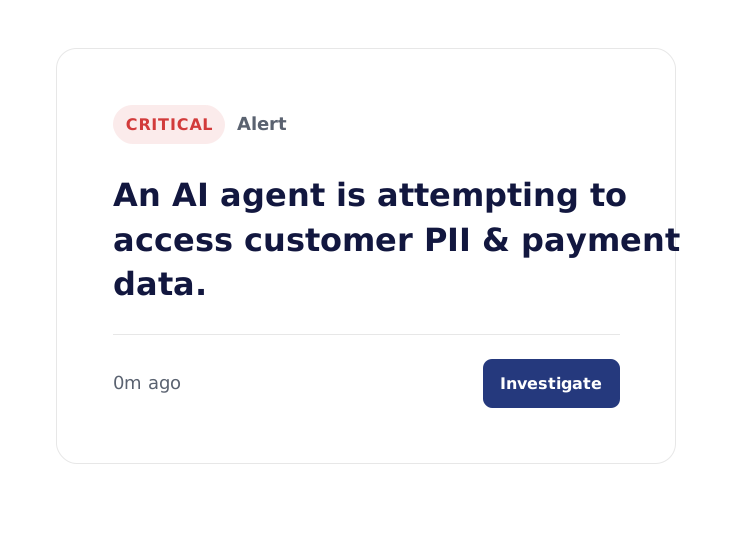
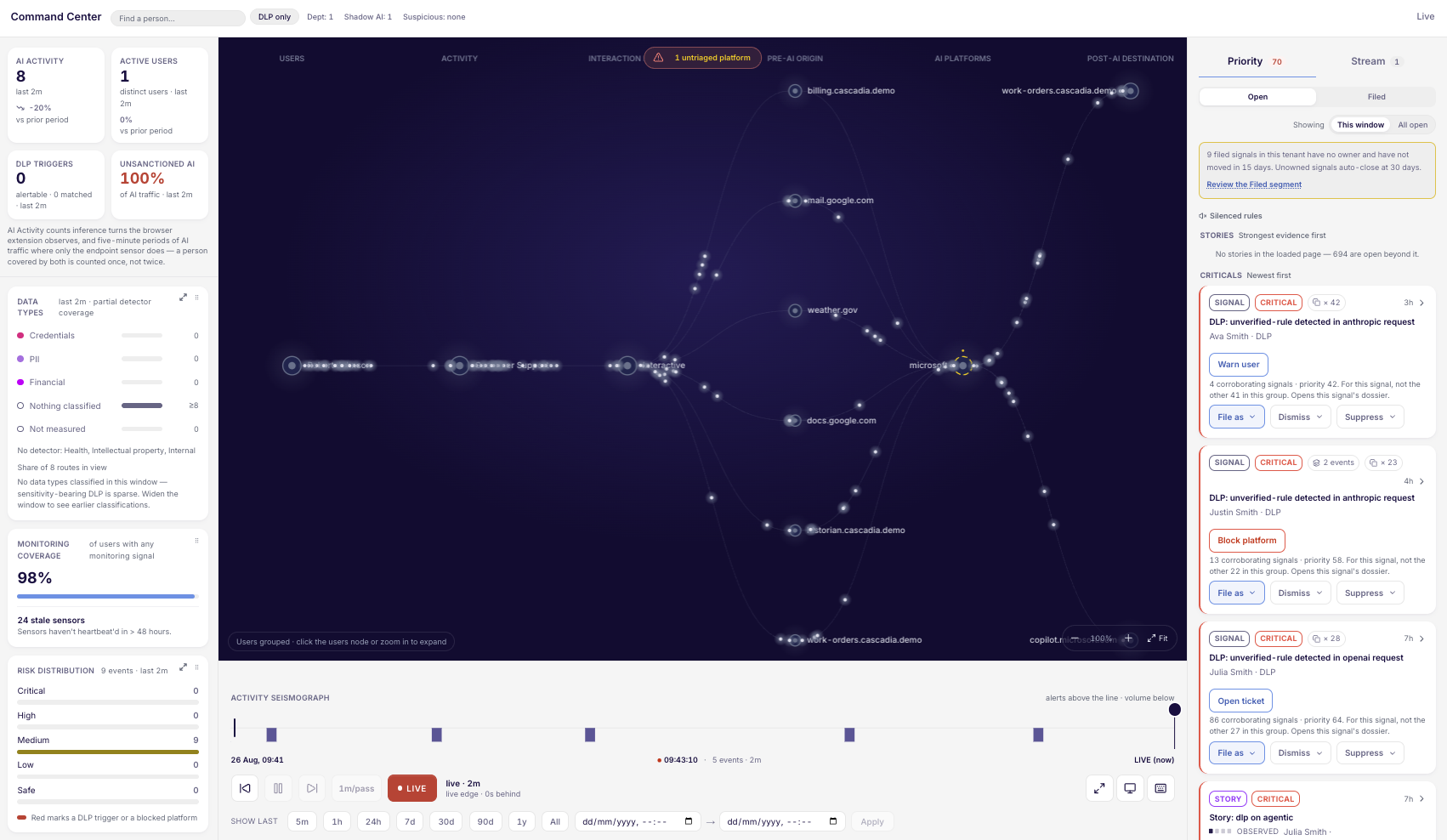
Full compliance attestation across four frameworks, a modeled dollar estimate from FAIR-based attack simulation, and a governance chain for every AI agent it discovers in your environment. When the board or the auditor asks, you already have the evidence.
Compliance readiness
Your readiness against every AI framework you are measured on.
ISO/IEC 42001:2023
Target Jan 2, 2027
Owner compliance.lead@cascadia.demo · Sponsor VP Information Security
Product coverage available0%
Available on 0/62
Operating effectively0%
Effective on 0/5
Automatable coverage0% machine-assisted
Class A — a collector evidences the control
18 · 29%
Class B — a collector informs a human judgment
20 · 32%
Class C — human-attested only
24 · 39%
A control with no collector is Not-evidenced, never a silent pass.
View controls →
214
controls mapped across ISO 42001, NIST AI RMF and the EU AI Act
to full deployment, no proxy or SSL inspection required
40 +
AI providers monitored on a continuously expanding watchlist
The Problem
The Evidence Gap
Every audit cycle, a compliance team is asked to prove something it can only describe. Not because the controls do not exist, but because the evidence lives in spreadsheets, screenshots, and a decision someone remembers making six months ago.
Ask your security team these questions and see how many they can answer with evidence.
If an auditor walked in tomorrow, what would you actually hand them?
Which of your AI governance controls are attested, and which are only assumed?
Do you know the dollar cost of your AI risk, or only a severity label?
If an AI agent went rogue tomorrow, could you name who owns it and what it can reach?
Annual attestations and policy documents were built for a point-in-time audit, not continuous AI governance.
The result: evidence that is stale before the audit even starts, assembled under deadline instead of maintained continuously.
CyberHQ.ai
Assumed AI Governance vs. Provable AI Governance with CyberHQ.ai
Most organizations govern AI with static policy documents and wishful thinking. CyberHQ.ai provides a continuously updated evidence record built for four major frameworks and direct audit readiness.
Assumed AI Governance
With CyberHQ.AI
Compliance is a once-a-year attestation exercise, compiled by hand.
Readiness programs track every framework toward your audit date, and audit engagements give your auditor a scoped, sampled evidence set.
Risk is reported as a red, amber, or green heat map with no dollar figure attached.
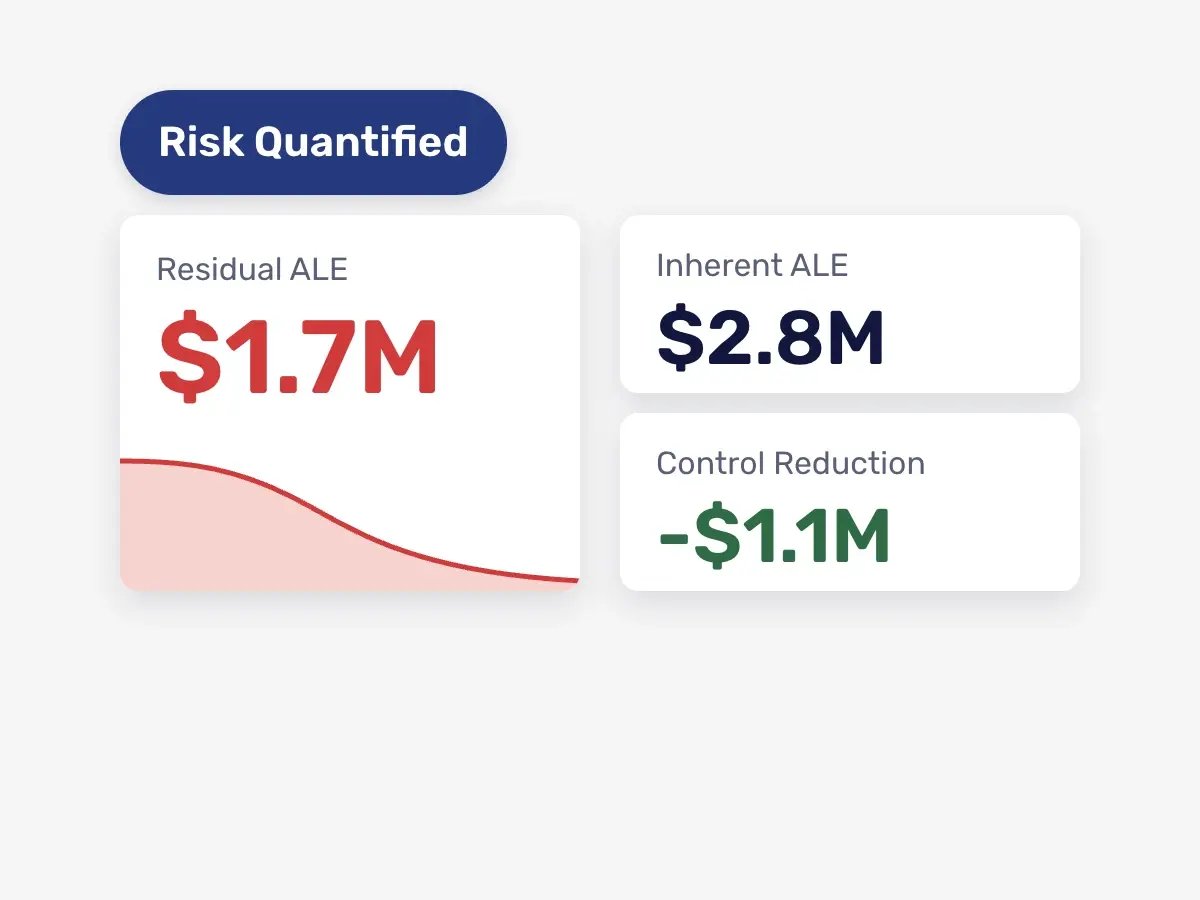
Attack Simulation produces a modeled Annualized Loss Expectancy estimate with a 1,000-iteration Monte Carlo confidence range, grounded in FAIR.
Autonomous AI agents run with standing access and no named accountable owner.
AI-agent governance maps each discovered agent's capabilities and privilege age, and lets you suspend or decommission it behind a confirmation step, with suspension enforcement in dry-run until you arm it.
When an auditor asks for evidence, someone spends a week compiling screenshots and spreadsheets.
An Audit Engagement Portal gives your auditor a scoped workspace tied to their own engagement record, an evidence sampling pack included, with no emailed spreadsheets and no access to your broader tenant.
Vendor risk is whatever the AI provider's own marketing page claims.
Vendor risk intelligence scores each AI provider's data handling, privacy posture, and regulatory exposure against the AI platforms your employees actually use.
The board gets a technical summary it cannot act on.
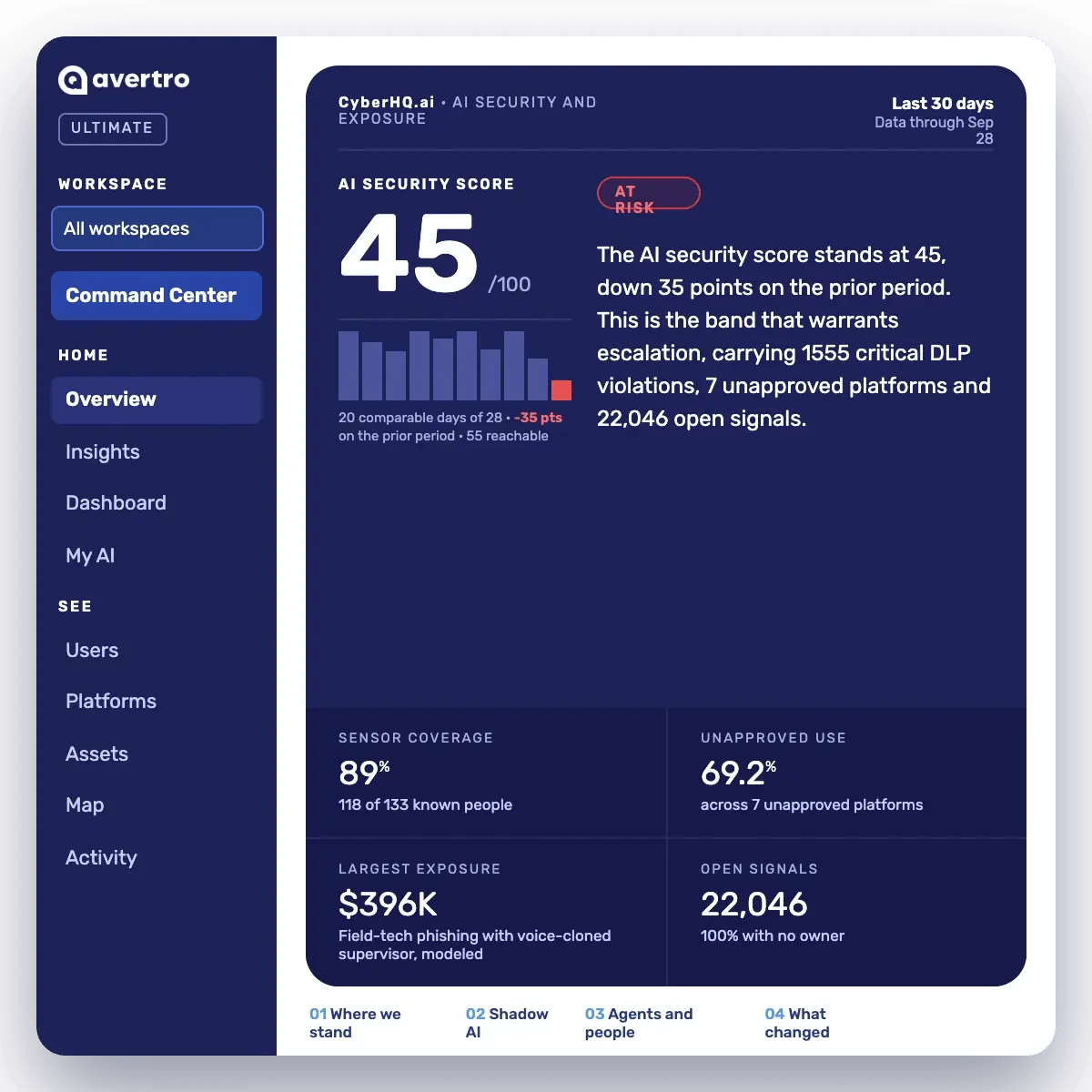
The AI Security Score rolls continuous telemetry into a single board-ready number, with up to 90 days of score history and PDF export in the overview brief for board decks.
Attack Simulation models Annualized Loss Expectancy across your users, platforms, and data. The board gets a number, not a severity label.
Prove every AI agent is accountable
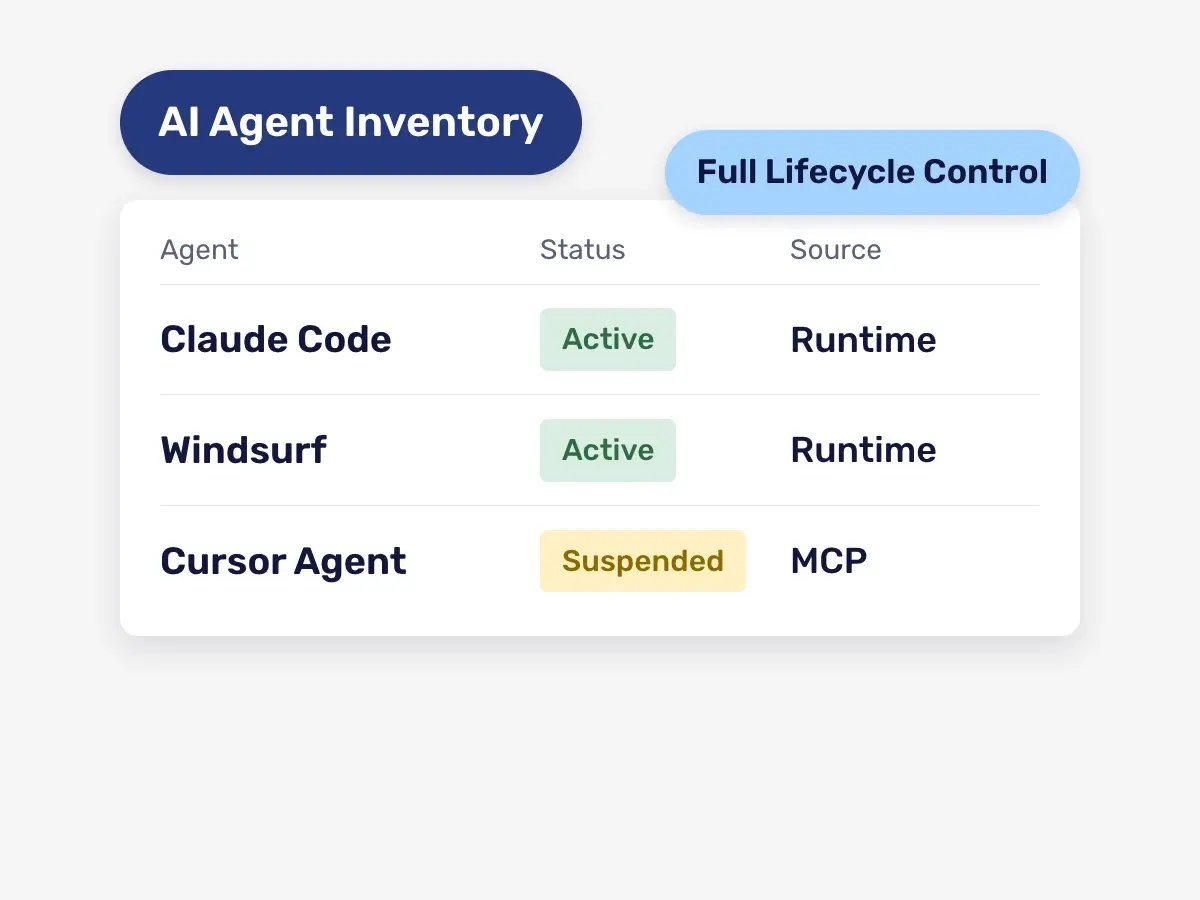
AI-agent governance discovers autonomous agents with capability maps, standing-privilege ages, and delegation-chain trails, with full lifecycle control behind a confirmation step.
AI Usage Insights
AI Usage Insights Within 48hrs Of Deployment
Start a free 30-day trial and see results on your insights dashboard within 48 hours of deploying your sensor.
What AI tools are moving through your organization
Who is using AI and how they are using it
How agentic AI is acting and what it's accessing
Which AI tools are putting your data at risk and why
Start your 30-day free trial
Built For Security Teams Ready to Act
Every Function Needs a Different Kind of Proof
CISO & Security Leader
How do I answer the auditor?
Readiness programs across four frameworks and an Audit Engagement Portal scoped to their review, with evidence sampling and challenge tracking built in.
Compliance Officer
Where do I start with ISO 42001?
Controls mapped, tracked in a readiness program toward your audit date, with auditor challenges and evidence samples handled inside the engagement.
CRO & Board
What is our AI risk actually worth?
Attack Simulation models Annualized Loss Expectancy, not a heat map. Forensics traces sensitive content into a signed evidence bundle.
Engineering & Operations
Are our AI agents accountable?
Every discovered agent is capability-mapped and governed from suspend to decommission, with MCP-server and machine-identity findings.
Key Capabilities
Full compliance attestation, four frameworks
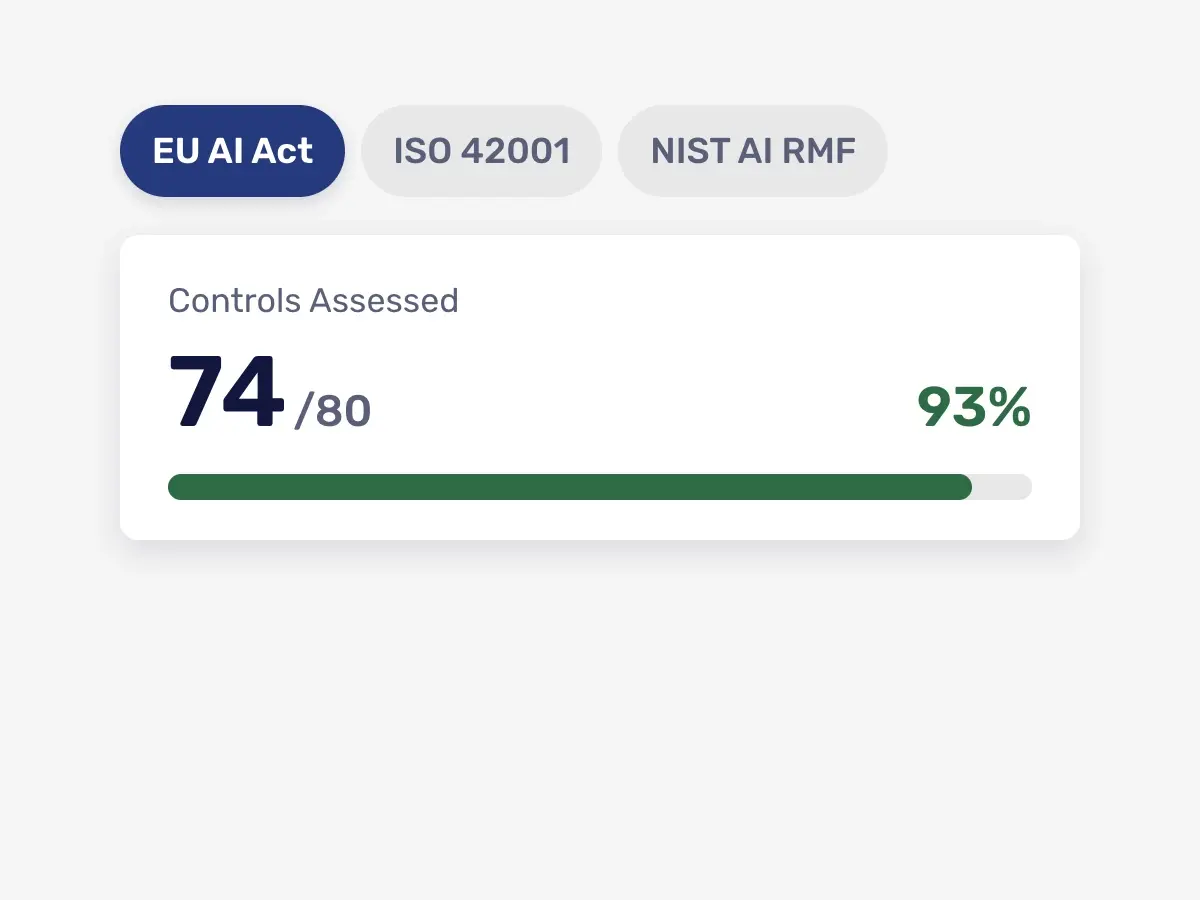
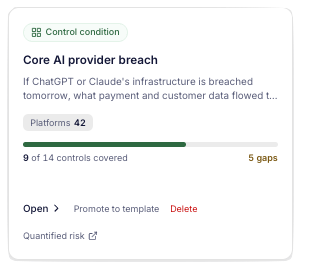
Controls mapped across ISO 42001, NIST AI RMF and EU AI Act, plus 35 MITRE ATLAS mitigations, organized into multi-framework readiness programs with consolidated reporting.
Audit engagement portal
A scoped workspace tied to your auditor's own engagement record, with no emailed spreadsheets and no access to your broader tenant.
Exposure chains and attack simulations
Chains link related events across users, platforms, and data into one inspectable narrative; simulations model a dollar-quantified Annualized Loss Expectancy estimate.
AI-agent governance
Discovers AI agents, maps their capabilities and privilege age, and lets you suspend them behind a confirmation step.
Vendor risk intelligence
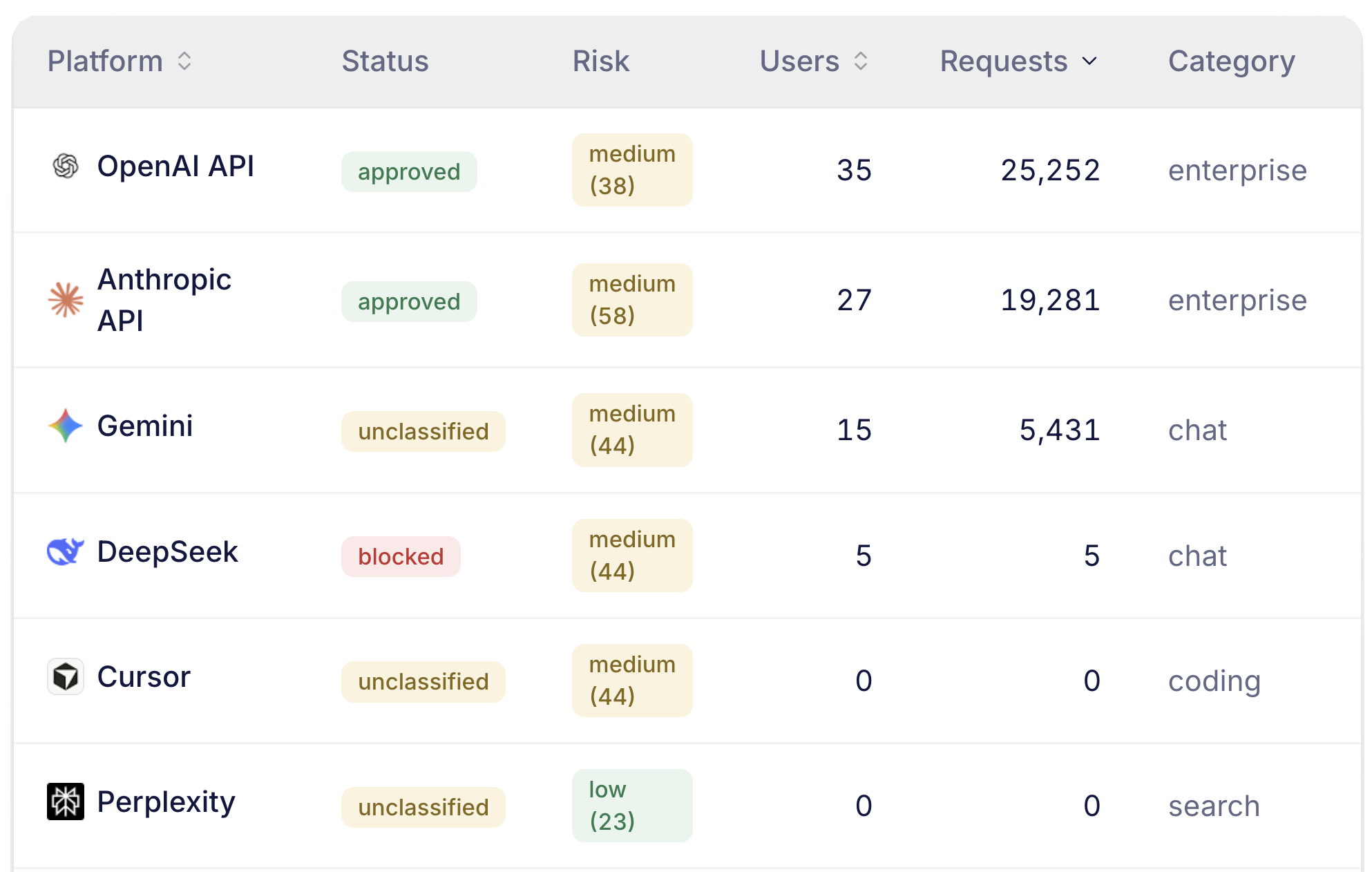
Scores each AI provider's risk against what your tenant actually uses, so irrelevant threats never clutter the inbox.
Hard enforcement block
Warns on or blocks unapproved AI platforms, sensitive pastes, and uploads inside the browser, not just an alert.
Iris AI-Assistant
Find your evidence quicker With Iris
Compliance evidence is only valuable if you can find it in seconds. When a board member asks about your AI governance posture or an auditor demands proof of a specific control, Iris, our conversational AI assistant, gives you instant answers tied directly to the underlying evidence.
ISO 42001
NIST AI RMF
EU AI Act
MITRE ATLAS
Iris
ChatInbox
Ask Iris
Ask anything about controls, frameworks, or evidence. Iris cites every claim.
Press Enter to ask0 / 2048
Iris is investigating your evidence...
AI · drafted
Frequently Asked Questions
What is the difference between See, Act, and Prove?
See gives you continuous shadow AI discovery, the endpoint sensor with device-level blocking, actor classification, and the AI Maturity Ladder. Act adds the AI Security Score, alert triage, custom DLP rules, incident response workflow, per-person block rules, and per-framework compliance attestation. Prove adds multi-framework compliance programs with audit engagements, browser-level blocking, attack simulation with a modeled dollar loss estimate, and AI-agent governance. Each tier includes everything below it.
Who is CyberHQ.AI's Prove tier best fit for?
Prove fits organizations with a formal AI governance or audit requirement, autonomous AI agents already running in the environment, or a board asking for governance reporting. If you don't yet have a compliance deadline or agents running unsupervised, See or Act is the better starting point.
Do we need Prove if we already have Act?
CyberHQ.ai's Act tier gives you per-framework attestation with three-lines-of-defense sign-off, a Statement of Applicability export, and nightly suggestions. Prove adds readiness programs with an Audit Engagement Portal, exposure chains, attack simulation with a modeled Annualized Loss Expectancy estimate, AI-agent governance, and the Iris assistant. A formal audit requirement, autonomous AI agents in the environment, or a board asking for governance reporting is the signal to move to Prove.
How long does CyberHQ.ai take to deploy?
Most organizations deploy CyberHQ.ai in under 30 minutes.
What is a three-lines-of-defense attestation chain?
It is the structure most internal audit functions already use: first-line control owners attest, second-line risk review checks that attestation, and third-line audit engages independently. CyberHQ.AI routes every control attestation through that chain automatically, recording each step append-only, backed by signed evidence snapshots for monitored controls, so what your auditor sees is exactly what happened.
What is an AI Governance Command Platform?
An AI Governance Command Platform gives a business a continuous, evidence-backed picture of how AI is actually being used across the organization, from first shadow AI discovery through usage insights, agent oversight, and audit-ready compliance. CyberHQ.AI is built to sit alongside your existing security stack, not replace it, and to answer three questions on an ongoing basis: how is AI being used right now, what does that usage expose you to, and can you prove you have control.
CyberHQ.ai
Prove your AI controls with evidence
Full compliance attestation across four frameworks, a modeled dollar estimate from FAIR-based attack simulation, and a governance chain for every AI agent it discovers in your environment.
-1.png?width=120&height=28&name=avertro-white-logo%20(1)-1.png "avertro-white-logo (1)-1")


.jpg)