-1.png?width=500&height=112&name=avertro-white-logo%20(1)-1.png "avertro-white-logo (1)-1")
NIST CSF 2.0 has moved beyond a framework update to become the global reference point for cyber governance, regulatory alignment, and board-level reporting. As enforcement of mandates like NIS2 and DORA accelerates, organisations are shifting from basic adoption to operationalisation. This guide revisits the NIST CSF Circuit Board to show how the new Govern function underpins modern compliance, executive visibility, and measurable cyber risk management in 2026.
NIST CSF 2.0 Implementation Guide: The Circuit Board Evolution (2026 Update)
Since its official release in early 2024, the NIST Cybersecurity Framework (CSF) 2.0 has transformed from a new standard into the global baseline for modern cyber governance.
While the framework introduced a major shift with the addition of the "Govern" function, the challenge for security leaders in 2026 is no longer just understanding the changes; it is operationalising them to satisfy new mandates like the EU’s NIS2 and DORA.
Below, we revisit our popular NIST CSF Circuit Board to visualise the evolution from version 1.1 and explore how modern CISOs are using these changes to drive Board visibility and regulatory compliance today.
The Foundation: NIST CSF 1.1 vs 2.0 Circuit Board
When NIST CSF 2.0 was first drafted, the biggest headline was the expansion of the core functions. What the NIST website didn't communicate at the time was the flow of those changes.
To visualise this, we created the "Circuit Board", which maps how the framework matured.
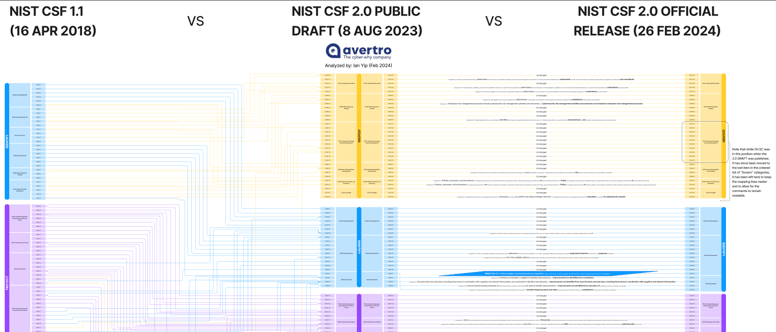
NIST CSF 1.1 to 2.0 circuit board - updated 26 February 2024
In summary:
The "Govern" (GV) Function: This was the headline change, recognising that cyber governance is not an IT task, but a strategic business requirement.
Supply Chain Security: We saw GV.SC (Cybersecurity Supply Chain Risk Management) shift to become a core component of the Governance function, a move that predicted the heavy supply chain focus of current 2025-2026 regulations.
Expanded Scope: The language was softened and broadened to apply to all organisations, not just critical infrastructure.
The 2026 Context: From "Adoption" to "Strategy"
Looking at the circuit board today, it is clear that NIST CSF 2.0 was designed for the current regulatory landscape. The static boxes on the diagram above have evolved into dynamic engines for compliance.
Here is how that governance layer comes to life in practice today, moving NIST CSF 2.0 from a conceptual framework into a practical operating model for security and risk leaders:
1. The "Govern" Function as the NIS2 Connector
The addition of Govern was prescient. Today, it maps directly to the "Management Bodies" accountability requirements found in the EU's NIS2 Directive.
Organisations that successfully implemented the Govern function in 2024 found themselves ahead of the curve when NIS2 enforcement ramped up. Specifically, the circuit board’s highlighted move of Supply Chain Risk into the Governance domain is now the standard for demonstrating third-party due diligence to regulators.
2. Speaking the Board’s Language
In 2024, the question was, "How do we implement NIST?" In 2026, the question is "How do we report on it?"
Boards, investors, and regulators now expect security leaders to communicate risk, maturity, and ROI in clear, strategic terms. The Governance function provides the taxonomy to bridge that gap. It allows CISOs to move away from reporting on "tickets closed" (Protect/Detect) to reporting on "strategy aligned" (Govern).
Adopting the framework is step one. Automating it is step two.
Many organisations are still managing their "Circuit Board" via spreadsheets, leading to stale data and a disconnect between cyber activity and business outcomes.
CyberHQ® was the first platform globally to support NIST CSF 2.0, but today, we go further. We don't just display the framework; we operationalise it.
-
Automated Mapping: Instantly map your controls to NIST CSF 2.0, NIS2, DORA, and ISO 27001 without manual cross-referencing.
-
Financial Translation: We use the Govern function to translate your technical data into financial metrics that the Board understands.
-
Always-On Compliance: Move from "point-in-time" assessments to continuous visibility.
Don't just track your maturity against the circuit board; use it to demonstrate ROI and secure your budget.